
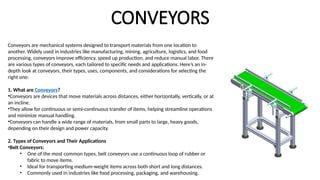
Conveyor systems are the backbone of modern material handling, powering everything from high-throughput e-commerce fulfillment centers to precision manufacturing lines. Selecting the right conveyor technology is a critical engineering decision that directly impacts operational efficiency, safety, and long-term cost of ownership. This guide examines the primary categories of conveyor systems and the applications where each delivers the greatest value.
Belt Conveyors
Belt conveyors are the most widely deployed material handling solution in industrial settings. A continuous loop of belting—typically constructed from rubber, PVC, or fabric-reinforced compounds—runs over a series of pulleys and rollers to transport goods along a fixed path.
Key Characteristics
- Capable of moving high volumes of product over long distances
- Handles a broad range of materials, from bulk aggregates to packaged goods
- Available in flat, inclined, and curved configurations
- Relatively low maintenance requirements with proper belt tensioning
Common Applications
Belt conveyors excel in bulk handling operations such as mining, grain processing, and port logistics, where they move raw materials continuously. In manufacturing and warehousing, they are widely used for transporting cartons, parcels, and loose components across production floors and sortation areas.
Roller Conveyors
Roller conveyors use a series of cylindrical rollers mounted in a frame to move loads. They are typically divided into two subcategories: gravity roller conveyors, which rely on a slight decline and the weight of the load to generate movement, and powered roller conveyors, which use motors, belts, or chains to drive the rollers.
Key Characteristics
- Well suited to items with flat, rigid bottoms such as cartons, pallets, and totes
- Gravity versions require no external power, reducing energy costs
- Powered versions support accumulation, zoning, and precise speed control
- Modular design simplifies reconfiguration and expansion
Common Applications
Gravity roller systems are common in loading docks, staging areas, and order picking zones where manual pushing is practical. Powered roller conveyors are integral to automated distribution centers, particularly in accumulation lanes and pallet handling systems where controlled, zero-pressure movement is required.
Chain Conveyors
Chain conveyors transmit motion through one or more continuous chains running in guide tracks. They are engineered for heavy-duty environments where durability and load capacity are paramount.
Key Characteristics
- Exceptional strength for transporting heavy or bulky loads
- Operates effectively in harsh conditions, including high temperatures and abrasive environments
- Supports pallet handling and overhead conveying configurations
- Requires regular lubrication and inspection to maximize service life
Common Applications
Chain conveyors are standard in automotive assembly, heavy equipment manufacturing, and palletized warehousing. Overhead chain systems, such as power-and-free conveyors, are frequently used in painting and finishing lines where products must be routed through multiple process stations.
Pneumatic and Vacuum Conveyors
Pneumatic conveyor systems move materials through enclosed tubes using air pressure or vacuum. Unlike mechanical conveyors, they contain no exposed moving parts along the transport path, which makes them ideal for applications demanding hygiene and contamination control.
Key Characteristics
- Fully enclosed transport protects materials from external contamination
- Flexible routing around obstacles and through walls
- Minimal product loss and dust generation
- Effective for powders, granules, and small components
Common Applications
These systems are heavily utilized in food processing, pharmaceutical manufacturing, and chemical handling, where sanitary standards and dust containment are non-negotiable. Vacuum conveyors are also common in plastics processing for transporting pellets and regrind.
Vibratory Conveyors
Vibratory conveyors move material through controlled oscillation rather than a moving belt. They are valued for their gentle handling characteristics and their ability to perform simultaneous functions such as screening, cooling, and spreading.
Key Characteristics
- Gentle product handling minimizes damage and degradation
- Sanitary design with minimal crevices supports easy cleaning
- Can integrate screening, dewatering, and cooling functions
- Limited to relatively short conveying distances
Common Applications
Vibratory conveyors are commonplace in snack food production, where fragile items such as chips and crackers require gentle transport. They are also used in recycling operations for sorting and spreading materials.
Comparison at a Glance
| Belt | High-volume, long-distance transport | Mining, logistics, manufacturing | Powered |
| Roller | Cartons, totes, and pallets | Warehousing, distribution | Gravity or powered |
| Chain | Heavy and palletized loads | Automotive, heavy equipment | Powered |
| Pneumatic | Powders, granules, sanitary transport | Food, pharma, chemicals | Powered (air) |
| Vibratory | Fragile products, screening, cooling | Food processing, recycling | Powered |
Selecting the Right System
Choosing a conveyor system requires a disciplined evaluation of several variables:
In practice, many facilities deploy hybrid systems that combine multiple conveyor types—for example, belt conveyors for inbound transport feeding into powered roller accumulation lines and sortation equipment. A thorough requirements analysis, conducted in partnership with an experienced systems integrator, remains the most reliable path to a conveyor architecture that scales with operational growth.