
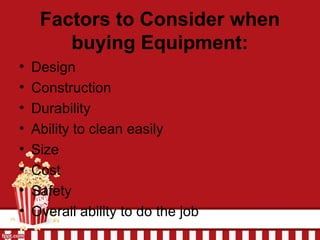
Industrial equipment represents one of the most consequential capital expenditures a technology-driven operation will make. Unlike consumer electronics or office hardware, industrial machinery often carries a service life measured in decades, integrates directly into production workflows, and carries downtime costs that can dwarf the purchase price itself. Whether you are outfitting a new facility or modernizing a legacy line, a disciplined evaluation process is essential. The following guide outlines the critical factors that should shape every industrial equipment purchasing decision.
Define Operational Requirements Before Evaluating Vendors
Purchasing decisions that begin with vendor catalogs rather than internal requirements almost always produce misaligned outcomes. Before engaging suppliers, document the operational envelope the equipment must satisfy.
- Throughput and capacity: Specify required output rates under normal and peak conditions, including headroom for projected growth.
- Process specifications: Document tolerances, material compatibility, cycle times, and any regulatory standards the equipment must meet.
- Environmental conditions: Account for temperature, humidity, particulates, vibration, and power quality at the installation site.
- Integration points: Identify upstream and downstream systems, communication protocols, and data requirements.
A requirements document serves a second purpose: it becomes the objective basis for comparing competing proposals, reducing the influence of persuasive sales narratives on the final decision.
Total Cost of Ownership Outweighs Sticker Price
The purchase price is only the first entry in a much longer ledger. Industrial equipment carries ongoing costs that frequently exceed the initial investment over its service life. A rigorous total cost of ownership (TCO) analysis should capture every category of expense.
| Acquisition | Purchase price, delivery, rigging, installation | One-time |
| Energy | Power draw, compressed air, cooling | Ongoing, monthly |
| Maintenance | Preventive service, spare parts, consumables | Ongoing, annual |
| Downtime | Lost production, recovery labor, scrap | Event-driven |
| End of life | Decommissioning, disposal, resale value | Terminal |
Energy efficiency deserves particular scrutiny. In continuous-duty applications, a modest difference in power consumption can translate into six-figure savings over a decade. Similarly, equipment that is inexpensive to buy but expensive to maintain often proves to be the costlier choice by a wide margin.
Evaluate Vendor Reliability and Support Infrastructure
Even the most capable machine becomes a liability if the manufacturer cannot support it. Vendor evaluation should extend well beyond the product specification sheet.
For technology-intensive equipment, also evaluate the vendor’s track record on software updates, cybersecurity patching, and long-term support commitments for embedded control systems.
Assess Compliance, Safety, and Connectivity
Regulatory and safety requirements vary by jurisdiction and industry, but certain obligations apply broadly. Verify that equipment carries the required certifications, meets applicable electrical and mechanical safety standards, and includes appropriate guarding, lockout provisions, and emergency-stop functionality.
Connectivity has become an equally important consideration. Modern industrial equipment increasingly participates in data-driven maintenance and production analytics. Confirm that the machinery supports the protocols your plant infrastructure uses, that data can be exported without proprietary lock-in, and that remote access features meet your organization’s security policies. Equipment purchased without these capabilities can become an isolated island in an otherwise connected operation.
Plan for Scalability and Lifecycle Management
Industrial assets outlive most strategic plans. Equipment specified only for today’s volumes may constrain tomorrow’s growth, while equipment oversized for speculative demand ties up capital unnecessarily. Seek a defensible middle ground: modular designs that can be expanded, interfaces that accommodate future automation, and spare capacity aligned with credible forecasts.
Finally, establish a lifecycle plan at the point of purchase. Define expected service intervals, budget for mid-life overhauls, and set criteria for eventual replacement or resale. Organizations that treat equipment acquisition as a lifecycle commitment rather than a transactional event consistently achieve lower cost per unit of output and fewer disruptive surprises.
Conclusion
Successful industrial equipment purchasing is a structured discipline, not a negotiation exercise. Define requirements rigorously, analyze total cost of ownership honestly, vet vendors on their support capabilities, verify compliance and connectivity, and plan for the asset’s full lifecycle. Companies that apply this framework consistently make capital decisions that hold up under operational pressure for years after the contract is signed.