
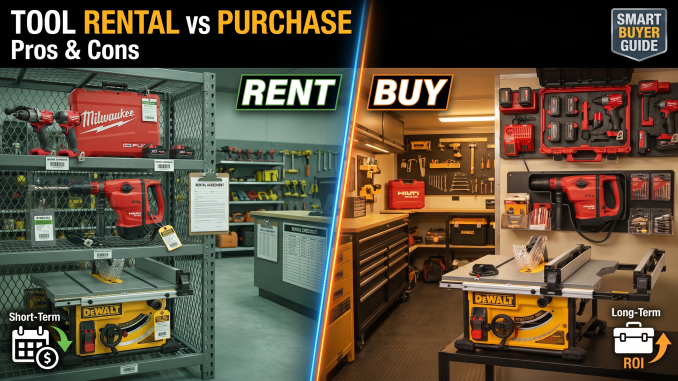
Capital allocation is one of the most consequential decisions an operations leader makes. When it comes to industrial equipment—excavators, CNC machines, forklifts, compressors, and specialized production assets—the rent-versus-buy question rarely has a universal answer. It depends on utilization rates, cash flow strategy, project timelines, and the total cost of ownership over the asset’s life. This guide breaks down the decision framework so you can choose with confidence rather than intuition.
Why the Decision Matters More Than Ever
Equipment costs have risen sharply, supply chains remain unpredictable, and financing rates have shifted the calculus for many organizations. At the same time, rental fleets have expanded to include highly specialized machinery that was once available only through purchase. The result: the rent-versus-buy decision now spans nearly every equipment category, and a misstep can tie up capital for years or expose a project to costly downtime.
A disciplined approach considers three pillars: financial impact, operational fit, and strategic flexibility. Evaluate each honestly before committing.
The Financial Case for Renting
Renting converts a capital expenditure into an operating expense. That distinction matters for businesses that guard cash reserves, maintain credit lines for growth, or operate under seasonal revenue cycles. Key financial advantages include:
- Preserved cash flow: No large upfront outlay, no down payment, and no financing fees.
- Predictable costs: Rental rates are fixed and often include maintenance, insurance, and servicing.
- Off-balance-sheet treatment: Short-term rentals may not appear as liabilities, which can improve key financial ratios.
- No depreciation exposure: You avoid the risk of owning an asset whose value drops faster than expected.
- Tax treatment: Rental payments are typically deductible as operating expenses, subject to your jurisdiction’s rules.
For projects with defined end dates—a six-month production ramp, a seasonal surge, or a single construction phase—renting frequently wins on pure economics.
The Financial Case for Purchasing
Ownership makes sense when an asset is central to your operation and will be used heavily over a long horizon. The financial arguments include:
- Lower long-term cost per hour: Once financing is retired, ownership costs drop to maintenance and consumables.
- Equity building: The asset becomes a balance-sheet item with residual value.
- Depreciation benefits: Accelerated depreciation schedules can deliver meaningful tax advantages.
- Insulation from rental rate inflation: Locked-in ownership costs protect against market rate spikes.
- Customization: Attachments, controls, and integrations can be tailored permanently to your workflow.
The break-even point typically arrives when annual utilization exceeds roughly 60 to 70 percent of available hours. Below that threshold, ownership costs—depreciation, storage, insurance, maintenance, and idle capital—tend to erode the advantage.
Operational Considerations Beyond the Spreadsheet
Utilization and Availability
Track actual usage data, not assumptions. If a machine sits idle for weeks between jobs, rental flexibility is worth more than ownership pride. Conversely, if a breakdown halts a production line, owning a dedicated unit with a service contract may be the safer bet.
Maintenance and Downtime
Rental agreements usually transfer maintenance responsibility to the provider, which reduces internal labor burden and downtime risk. Ownership requires in-house technicians, spare parts inventory, and a maintenance schedule—costs that are easy to underestimate.
Technology Obsolescence
In fast-moving categories such as automation, robotics, and precision machining, equipment can become outdated within a few years. Renting or leasing allows you to upgrade at contract renewal rather than absorbing a resale loss.
Storage and Logistics
Owned equipment demands yard space, security, insurance, and transport planning. For distributed job sites or short-duration projects, rental providers handle delivery, pickup, and repositioning.
Side-by-Side Comparison
| Upfront capital | Minimal; pay as you use | High; requires financing or cash |
| Utilization threshold | Best below 60–70% annual use | Best above 60–70% annual use |
| Maintenance burden | Typically included | Fully your responsibility |
| Flexibility | Swap, scale, or exit quickly | Fixed asset; resale required to exit |
| Long-term cost | Higher per hour over time | Lower once financed and depreciated |
| Tax treatment | Operating expense deduction | Depreciation and interest deductions |
| Customization | Limited to fleet options | Full control over configuration |
A Practical Decision Framework
Use the following sequence to structure the evaluation:
Hybrid Approaches Worth Considering
The choice is not always binary. Several middle paths deserve evaluation:
- Lease-to-own: Build equity while spreading payments, often with maintenance included.
- Rent with purchase option: Apply a portion of rental fees toward a future purchase.
- Own the core, rent the peak: Purchase equipment for baseline demand and rent to cover seasonal spikes.
The Bottom Line
Rent when utilization is low or uncertain, when cash preservation matters, or when technology risk is high. Buy when an asset is heavily used, central to your operations, and likely to deliver returns over many years. The most reliable decisions come from data-driven utilization analysis and an honest total-cost comparison—not from habit or headline pricing. Treat every major equipment decision as a financial and operational case study, and you will allocate capital where it creates the most durable advantage.