
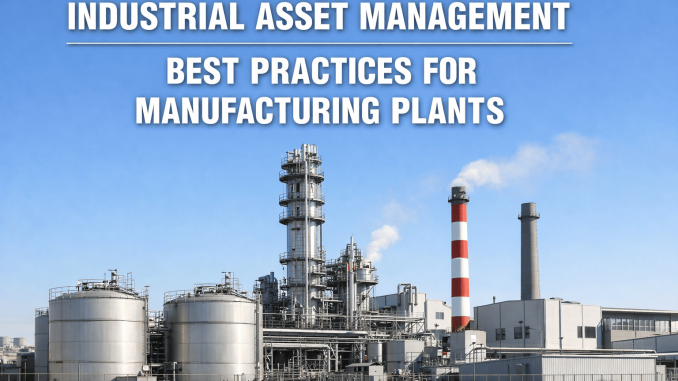
Industrial equipment represents one of the largest capital investments any manufacturing or processing operation will make. Yet far too many organizations treat maintenance as a reactive cost center rather than a strategic function. The consequences are predictable: unplanned downtime, shortened asset lifespans, inflated operating costs, and safety incidents that erode both margins and trust.
This guide outlines the maintenance best practices that distinguish high-performing industrial operations from those perpetually fighting fires. Whether you manage a single production line or a multi-site enterprise, these principles form the foundation of a resilient, cost-effective maintenance program.
1. Shift from Reactive to Predictive Maintenance
The most consequential decision in any maintenance strategy is where you sit on the reactive-to-predictive spectrum. Reactive maintenance—fixing equipment only after failure—remains surprisingly common, but it is almost always the most expensive approach when you account for downtime, secondary damage, and emergency labor premiums.
The Maintenance Maturity Spectrum
| Reactive | Equipment failure | Highest total cost | Non-critical, low-cost components |
| Preventive | Calendar or runtime intervals | Moderate, with some waste | Stable, predictable wear patterns |
| Condition-Based | Monitored parameter thresholds | Optimized | Rotating equipment, critical assets |
| Predictive | Analytics and trend modeling | Lowest total cost at scale | High-value, data-rich equipment |
Predictive maintenance leverages vibration analysis, thermography, oil analysis, and ultrasonic inspection to detect degradation before failure occurs. Combined with Industrial Internet of Things (IIoT) sensors and machine learning models, modern predictive programs can forecast remaining useful life with impressive accuracy—allowing maintenance to be scheduled precisely when needed, not before and certainly not after.
2. Build a Robust Asset Registry and Criticality Ranking
You cannot maintain what you have not catalogued. A comprehensive asset registry should capture every maintainable item, its specifications, maintenance history, spare parts requirements, and documentation. From there, apply a criticality ranking that weighs factors such as production impact, safety exposure, redundancy availability, and replacement lead time.
Criticality ranking prevents the common failure mode of spreading maintenance resources evenly across all equipment. Instead, it directs your most sophisticated monitoring and most rigorous procedures toward the assets that genuinely matter.
- Class A (Critical): Failure halts production or creates safety risk—warrants predictive monitoring and redundant spares.
- Class B (Important): Failure causes disruption but has workarounds—condition-based maintenance is appropriate.
- Class C (Standard): Failure is tolerable short-term—preventive or run-to-failure strategies apply.
3. Standardize Work Through Documented Procedures
Institutional knowledge locked in the heads of senior technicians is a liability, not an asset. Standardized maintenance procedures—complete with torque specifications, safety steps, acceptance criteria, and required tools—ensure consistency, accelerate onboarding, and reduce variability-driven failures.
Documented procedures also enable meaningful continuous improvement. You can only refine a process you can measure, and you can only measure a process that is performed consistently. Pair written procedures with visual job aids and digital checklists to drive adherence on the floor.
4. Implement a CMMS and Use It Disciplined
A Computerized Maintenance Management System (CMMS) is the operational backbone of any serious maintenance program. It should handle work order management, preventive maintenance scheduling, spare parts inventory, asset history, and reporting. The software matters far less than the discipline of using it.
Organizations that treat their CMMS as a compliance checkbox generate data that goes nowhere. Those that treat it as a decision-support tool unlock compounding improvements in reliability and cost.
5. Invest in Spare Parts Strategy and Inventory Discipline
Spare parts management is where maintenance budgets quietly bleed. Overstocking ties up capital and invites obsolescence; understocking turns a two-hour repair into a two-week outage. The right approach ties inventory levels directly to criticality and lead time.
- Maintain critical spares on-site for Class A assets, even at premium carrying cost.
- Negotiate vendor-managed inventory or consignment arrangements for high-value, slow-moving parts.
- Establish reorder points based on consumption data, not intuition.
- Audit inventory annually and purge obsolete stock ruthlessly.
6. Develop Your Technicians Continuously
Technology is transforming maintenance—from IIoT sensors to augmented reality work instructions—but skilled people remain the decisive factor. Build a structured training program covering equipment-specific competencies, reliability fundamentals, safety protocols, and digital tool proficiency.
Cross-training deserves particular emphasis. A maintenance team where every task depends on one specialist is fragile by design. Deliberate cross-training reduces single points of failure and improves scheduling flexibility.
7. Embed Safety into Every Maintenance Task
Maintenance work carries elevated risk: energized systems, stored energy, confined spaces, and heavy components. Safety must be engineered into procedures rather than appended as an afterthought. Lockout/tagout discipline, permit systems, pre-task hazard assessments, and proper personal protective equipment are non-negotiable foundations.
Strong maintenance organizations treat near-misses as free lessons and investigate them with the same rigor as recordable incidents. A culture where technicians feel empowered to stop unsafe work is worth more than any policy document.
8. Measure, Review, and Improve Continuously
Best practices are not static. Establish a monthly maintenance review that examines performance metrics against targets, reviews significant failures with root cause analysis, and adjusts strategy accordingly. Track leading indicators—PM compliance, training hours, backlog age—alongside lagging indicators like downtime and cost per asset.
The organizations that excel at industrial maintenance share a common trait: they treat reliability as a discipline to be practiced daily, not a project to be completed. Start with criticality ranking and a disciplined CMMS, layer in predictive technologies as your data matures, and invest relentlessly in your people. The returns—in uptime, safety, and total cost of ownership—follow reliably.