
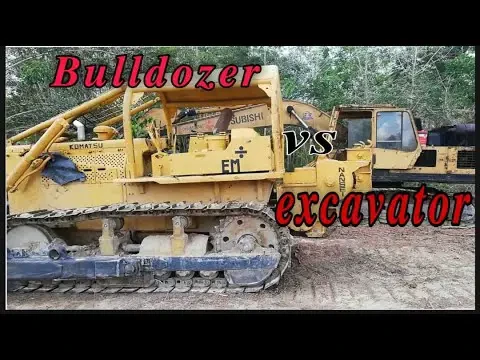
In the world of heavy construction equipment, few machines are as iconic—or as frequently confused—as the excavator and the bulldozer. Both are tracked, diesel-powered giants that dominate job sites, and to the untrained eye they can appear interchangeable. In reality, these two machines are engineered for fundamentally different tasks, and understanding those differences is essential for project planning, equipment procurement, and operational efficiency. This guide breaks down the key distinctions between excavators and bulldozers so you can specify the right machine for the job.
What Is an Excavator?
An excavator is a heavy-duty machine built around a rotating upper structure (the “house”) mounted on a tracked or wheeled undercarriage. Its defining feature is an articulated boom, stick, and bucket assembly that digs, lifts, and swings material with precision. Modern excavators range from compact mini units weighing under two tons to massive mining-class machines exceeding 800 tons.
The excavator’s core strength lies in its versatility. With the right attachment—bucket, breaker, grapple, auger, or shear—a single carrier can perform excavation, demolition, trenching, lifting, and material handling. The 360-degree swing capability allows the operator to dig, lift, and deposit material without repositioning the machine, which is a decisive advantage in confined spaces.
What Is a Bulldozer?
A bulldozer is a crawler tractor equipped with a large, curved blade mounted on the front. Its primary function is to push material—soil, rock, debris, sand—across the ground, typically over short distances. Bulldozers are the definitive machines for earthmoving at scale: clearing sites, leveling terrain, stockpiling aggregate, and ripping compacted ground with a rear-mounted ripper.
Where the excavator digs and lifts, the bulldozer pushes and grades. Its low center of gravity, wide tracks, and powerful blade make it exceptionally stable and productive when moving large volumes of material horizontally. Track-type tractors are also prized for their ability to operate on steep slopes and soft ground where wheeled machines would lose traction.
Excavators vs Bulldozers: Core Differences at a Glance
| Primary function | Digging, lifting, and swinging material | Pushing and grading material |
| Working motion | Articulated boom and bucket; 360-degree swing | Forward push with a front-mounted blade |
| Best for | Trenching, demolition, loading trucks, precision work | Bulk earthmoving, site clearing, leveling, ripping |
| Mobility on site | Stationary base with rotating upper structure | Continuous forward and reverse travel |
| Attachment flexibility | Very high (breakers, grapples, augers, shears) | Moderate (blades, rippers, winches) |
| Typical material handling | Lifts and loads material | Pushes and spreads material |
Digging and Lifting vs Pushing and Grading
The most fundamental distinction is the direction of work. An excavator reaches out and down, excavating material and lifting it into a haul truck or stockpile. This makes it the machine of choice for trenching, foundation excavation, utility installation, and loading operations. Its ability to work below grade—digging deep basements or drainage channels—is unmatched by any other standard earthmoving machine.
A bulldozer, by contrast, works forward and along the ground. It shears and rolls soil ahead of the blade, making it ideal for clearing vegetation, pushing spoil, cutting haul roads, and achieving rough grades. Where an excavator excels at precision and vertical reach, the bulldozer excels at volume and horizontal displacement.
Productivity and Site Conditions
Choosing between the two often comes down to site conditions and production goals. Bulldozers are most productive on open terrain where material must be moved over distances of roughly 30 to 100 meters; beyond that, hauling with trucks and loading with an excavator becomes more economical. Excavators thrive in tight quarters—urban sites, road corridors, and excavations—where their swing capability and attachment range provide access that a dozer cannot achieve.
Ground conditions also matter. Both machines are typically tracked, but bulldozers are engineered for low ground pressure and superior traction on soft or sloping ground. Excavators can operate on unstable surfaces using outriggers or widened track frames, but their stability is optimized for lifting rather than sustained pushing.
Cost, Maintenance, and Fleet Strategy
Purchase prices vary widely by size class, but as a rule, a comparable excavator carries a higher acquisition cost than a bulldozer of similar operating weight, reflecting its more complex hydraulics and swing mechanism. Undercarriage wear is a major cost driver for both machines, particularly for bulldozers, which log extensive travel hours. Maintenance programs should prioritize track inspection, hydraulic system health, and blade or bucket wear parts.
In fleet strategy, the two machines are complementary rather than competing. A typical earthmoving spread pairs bulldozers for clearing and bulk pushing with excavators for loading, trenching, and precision excavation. Contractors who understand each machine’s sweet spot can reduce cycle times, lower fuel consumption per cubic meter moved, and avoid the costly mistake of forcing one machine to do the other’s job.
Key Takeaways
- Excavators dig, lift, and swing; bulldozers push and grade.
- Excavators offer superior attachment versatility and precision in confined spaces.
- Bulldozers dominate bulk earthmoving over short distances and on challenging terrain.
- The machines are complementary—the best fleets deploy both according to task.
Ultimately, the excavator-versus-bulldozer question has no single winner. The right answer depends on what the job demands: vertical precision and material handling, or horizontal power and volume. Specify according to the task, and both machines will earn their place on the site.