
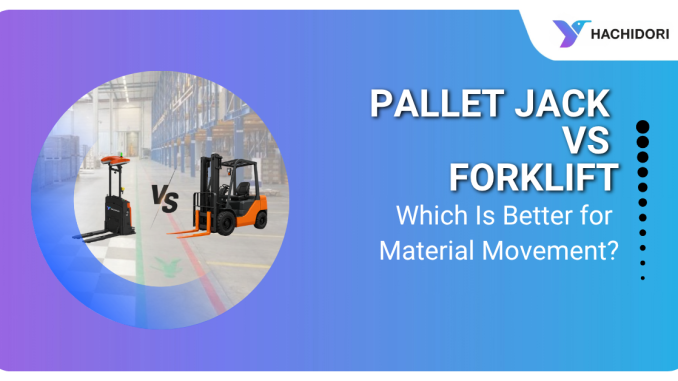
Warehouse efficiency hinges on moving goods quickly, safely, and cost-effectively. Yet one of the most consequential equipment decisions often receives the least analysis: choosing between forklifts and pallet jacks. Both assets handle palletized loads, but they serve fundamentally different operational profiles. Selecting the wrong one can inflate labor costs, slow throughput, or introduce unnecessary safety exposure. This guide breaks down the trade-offs so you can match equipment to your facility’s real-world demands.
Understanding the Core Difference
A forklift is a powered industrial truck designed to lift and transport heavy loads, typically stacking them at height. A pallet jack is a lower-profile device—manual or electric—built primarily to move pallets horizontally at floor level. The distinction sounds simple, but it cascades into major differences in capacity, cost, training requirements, and workflow design.
Forklifts at a Glance
- Power source: Electric, propane, diesel, or gas
- Lift capacity: Commonly 3,000 to 15,000+ lbs
- Lift height: Capable of reaching racking systems several stories high
- Operator requirements: Formal certification under OSHA standards
- Best for: High-volume facilities, vertical storage, dock operations
Pallet Jacks at a Glance
- Power source: Manual (hydraulic pump) or electric (walk-behind)
- Lift capacity: Typically 2,500 to 5,500 lbs
- Lift height: Limited to a few inches—enough to clear the floor
- Operator requirements: Minimal training; no certification in most cases
- Best for: Floor-level transport, small facilities, order picking support
Head-to-Head Comparison
| Upfront cost | High ($20,000–$50,000+) | Low ($300–$5,000) |
| Operating cost | Fuel, maintenance, certified labor | Minimal; manual models need no power |
| Vertical stacking | Yes, up to rack heights | No |
| Throughput speed | High over distance and height | Moderate; best for short hauls |
| Space requirements | Wide aisles required | Operates in tight aisles |
| Safety training | Mandatory certification | Basic orientation |
When a Forklift Is the Right Choice
Forklifts earn their cost when your operation depends on vertical storage or heavy loads. Consider them if:
Keep in mind that forklifts demand wider aisles, certified operators, and a maintenance program. Those costs are real—but they buy capabilities no pallet jack can replicate.
When a Pallet Jack Is the Right Choice
Pallet jacks shine in lean, floor-level, short-distance environments. They are the smarter investment when:
For many small and mid-sized warehouses, a fleet of electric pallet jacks covers 70–80% of daily movement needs at a fraction of forklift costs.
The Hybrid Approach: Don’t Choose Just One
The most efficient warehouses rarely standardize on a single equipment type. A practical model looks like this:
- Forklifts handle receiving, put-away to racking, and outbound loading.
- Electric pallet jacks handle floor-level replenishment, cross-docking, and picking support.
- Manual pallet jacks serve as low-cost backup and short-haul movers in tight zones.
This tiered strategy balances capital expenditure against throughput, and it keeps expensive powered equipment focused on work only it can perform.
Key Decision Factors to Weigh
Facility Layout
Aisle width, ceiling height, and rack configuration often decide the question before budget even enters the conversation. Narrow aisles favor pallet jacks; vertical racking requires forklifts.
Load Profile
Map your average and peak pallet weights. If peaks regularly exceed 5,000 lbs, forklifts become the safer, more durable option.
Labor and Training
OSHA requires forklift operators to be trained and evaluated. Factor certification time and turnover into your total cost of ownership.
Total Cost of Ownership
Compare purchase price against maintenance, fuel or charging, training, and insurance. A $30,000 forklift may be cheaper per pallet moved than a $400 manual jack if it eliminates two labor hours per shift—context determines the winner.
Final Verdict
There is no universal answer—only the right fit for your operation. Choose forklifts when height, weight, and throughput define your workflow. Choose pallet jacks when speed of deployment, tight spaces, and lean budgets take priority. And in most growing warehouses, the optimal path is a deliberate mix of both, matched to the specific tasks each performs best. Audit your load profiles and facility layout first; the equipment decision will follow naturally.