

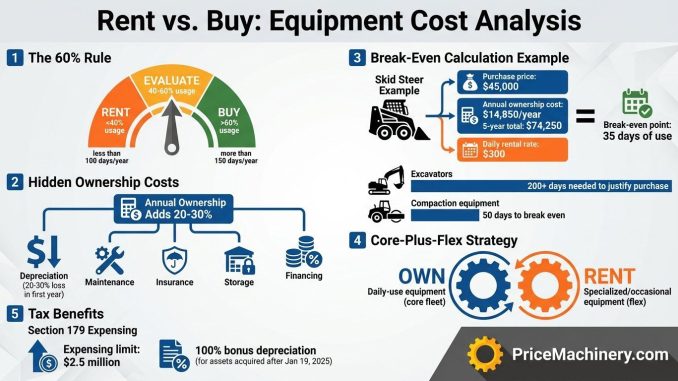
For healthcare organizations, the decision to rent or purchase medical equipment carries significant financial and operational implications. Whether you run a small clinic, a growing urgent care center, or a large hospital system, the right acquisition strategy depends on a range of factors—from capital availability and usage frequency to reimbursement pressures and technology lifecycles. This guide breaks down the essential considerations to help you make an informed, cost-effective choice.
Understanding the Core Trade-Offs
At its heart, the rent-versus-buy decision balances capital expenditure (CapEx) against operating expenditure (OpEx). Buying converts cash into a long-term asset, while renting preserves liquidity in exchange for ongoing payments. Neither approach is universally superior; the optimal choice depends on how the equipment fits into your organization’s financial and clinical strategy.
Financial Considerations
Cash Flow and Capital Preservation
Purchasing equipment typically requires a substantial upfront investment. For organizations with limited capital budgets or competing priorities, renting can free up cash for staffing, facility improvements, or other critical initiatives. Renting also simplifies budgeting, since costs are predictable and spread across the contract term.
Total Cost of Ownership
Buying may deliver a lower total cost of ownership over the equipment’s useful life—particularly for high-utilization devices. However, this advantage depends on accounting for maintenance, service contracts, calibration, insurance, and depreciation. Rental agreements often bundle service and support into a single fee, which can reduce hidden costs but may cost more over time if usage is high.
Tax and Accounting Treatment
Rental payments are generally treated as operating expenses, which can be advantageous for organizations seeking to reduce taxable income. Purchases may qualify for depreciation schedules, Section 179 deductions, or favorable financing terms. Consult your finance team or a healthcare accountant to model both scenarios accurately.
Operational and Clinical Factors
Usage Frequency and Duration
The single most important operational question is: how often will you use this equipment? Devices used daily—such as infusion pumps or patient monitors—often justify purchase. Equipment needed for seasonal surges, short-term projects, or occasional procedures is frequently better rented.
Technology Lifecycle and Obsolescence
Medical technology evolves rapidly. Renting provides flexibility to upgrade to newer models without absorbing the depreciation of aging assets. For imaging systems, specialized diagnostic tools, and other fast-moving categories, rental or equipment-as-a-service arrangements can protect you from premature obsolescence.
Maintenance and Downtime
Rental providers typically assume responsibility for maintenance, repairs, and replacement units, reducing your biomedical engineering burden. When you buy, you own uptime risk: service contracts, spare parts inventories, and backup equipment all become your responsibility.
Compliance, Reimbursement, and Risk
Regulatory requirements apply regardless of ownership model. Ensure rented equipment meets applicable standards, including calibration records, preventive maintenance documentation, and safety certifications. From a reimbursement perspective, verify that rental costs are allowable under your payers’ rules and that equipment use supports billed services. Additionally, review rental agreements carefully for liability, indemnification, and insurance clauses.
Comparing Rental and Purchase at a Glance
| Upfront cost | Low | High |
| Budget treatment | Operating expense | Capital expense |
| Maintenance responsibility | Often included | Owner’s responsibility |
| Upgrade flexibility | High | Low to moderate |
| Long-term cost at high usage | Higher | Lower |
| Asset ownership | None | Full |
When Renting Makes Sense
- Short-term or seasonal needs: Surge capacity, temporary clinics, or trial deployments.
- Rapidly evolving technology: Devices likely to be superseded within a few years.
- Capital constraints: Organizations preserving cash for core operations.
- Low-utilization equipment: Specialty devices used infrequently.
- Risk transfer priorities: Teams seeking to offload maintenance and uptime obligations.
When Buying Makes Sense
- High, sustained utilization: Equipment integral to daily clinical workflows.
- Long useful life: Stable technology with predictable service costs.
- Available capital or favorable financing: Strong balance sheets or low-cost loans.
- Customization requirements: Configurations or integrations impractical under rental terms.
- Strategic asset control: Situations where ownership supports accreditation, research, or competitive positioning.
A Practical Decision Framework
Final Thoughts
There is no one-size-fits-all answer to the rent-versus-buy question. The most effective strategy is often a hybrid model: purchasing high-utilization core equipment while renting specialty, seasonal, or emerging-technology devices. By rigorously analyzing cash flow, usage patterns, technology risk, and contractual terms, healthcare leaders can secure the equipment they need without compromising financial stability or patient care.